
Merchant Service Provider vs Payment Gateway: What Are The Differences?
Merchant Service Providers and Payment Gateways are important tools within the payment infrastructure. The difference between the two is that a Merchant Service Provider provides a merchant account, underwrites transaction risk, and settles funds into a business bank account whilst a Payment Gateway operates as the software that captures card data at checkout and transmits it to the payment processor.
An MSP controls the full payment lifecycle, including fund flow and dispute handling. MSPs suits businesses needing settlement, POS hardware, and risk control, while a payment gateway suits businesses transacting online payments, utilises API integrations, and multi-currency routing, though both often work together in a single payment stack.
Below we will discuss the main difference between a Merchant Service Provider vs a Payment Gateway, which businesses need MSPs and payment gateways and the advantages of each over the other.
What is the Difference between a Merchant Service Provider vs a Payment Gateway?
A merchant service provider (MSP) provides a dedicated merchant account, underwrites transaction risk, and settles funds into a business bank account whereas a payment gateway is the software that securely captures, encrypts, and transmits card data between the website and the payment processor. A MSP provides the whole payment infrastructure to accept, process, and settle card payments whilst providing chargeback management, fraud monitoring, and FCA-regulated compliance.
- A merchant service provider (MSP) manages the full payment lifecycle on behalf of a business, providing the merchant account, underwriting transaction risk, and ensuring FCA-regulated compliance. It handles fund settlement, chargeback resolution, and fraud monitoring, transferring funds from the customer’s bank into the business bank account.
- The payment gateway acts as the technical intermediary between the customer and the business, capturing and encrypting card data before transmitting it securely to the payment processor for authorisation. It enforces PCI-DSS compliance, applies 3D Secure (3DS2) authentication, and routes the authorisation response back to the checkout point in real time.
| Merchant Service Provider (MSP) | Payment Gateway | |
| Purpose | Deliver full financial infrastructure to accept, process, and settle card payments. | Securely captures, encrypts, and transmits card data between the website and the processor |
| Account Type | Provides a dedicated merchant account to hold and process funds | Holds no funds and operates no bank account |
| Key Functions | Fund settlement, chargeback management, fraud monitoring, risk underwriting | Data encryption, transaction authorisation, fraud screening at point of transmission |
| Regulatory Framework | FCA-regulated, operates under UK acquiring bank agreements | Not FCA-regulated as a financial entity |
| Technical Compliance | PCI-DSS compliant as part of the broader payment infrastructure | PCI-DSS compliant |
| Who Holds Funds | Holds funds in the merchant account before transferring to business bank account | Does not hold or settle funds at any point |
| Merchant ID (MID) | Issues a Merchant ID (MID) under UK acquiring bank agreements | Does not issue a MID |
| Standalone or Bundled | Can operate independently or bundle a payment gateway within its offering | Standalone tool |
What is a Merchant Service Provider?
A Merchant Service Provider (MSPs) is a third-party financial intermediary enabling businesses to accept and process electronic payments such as credit cards, debit cards, and online transactions. This provider establishes the core technical and financial infrastructure required to transfer funds between businesses, customers, banks, and payment card networks.
Merchant Service Providers deliver merchant services to businesses to help improve payment operations beyond the core infrastructure of processing payments. These providers supply hardware and software such as POS terminals, mobile card readers, and payment gateways. They facilitate online transactions through e-commerce integration, virtual terminals, and recurring billing systems.
The key features of merchant service providers are listed below:
- Payment Processing: Merchant service providers process payment authorisation requests from the point of sale to card networks and issuing banks for approval or denial.
- Merchant Account Setup: where customer payments are deposited before transfer to the business’s account.
- Hardware and Software Solutions: such as card readers, POS terminals, and software platforms for online payments.
- Security & Compliance: through encryption, tokenisation, and PCI DSS compliance protocols to protect cardholder information and prevent fraudulent transactions.
- Multichannel Payment Acceptance: across POS systems, e-commerce platforms, mobile applications, and contactless technology to accommodate diverse customer payment preferences.
Who Needs a Merchant Service Provider?
Any business that accepts credit or debit card payments in-person, online or over the phone needs a merchant service provider to securely process funds into a business bank account.
Businesses that specifically need a merchant service provider include:
- Brick-and-mortar retailers that require in-person POS terminals with multiple payment methods such as card payment, digital wallet and contactless payments.
- E-commerce businesses that process high volumes of card-not-present (CNP) transactions and require chargeback management and fraud controls
- Service professionals such as accountants, solicitors, and consultants who invoice clients and need to accept card payments over the phone
- Subscription-based businesses that require recurring billing infrastructure tied to a dedicated merchant account
- High-risk merchants that require a provider capable of underwriting transaction risk and maintaining acquiring bank relationships under UK financial regulations
What are the Advantages of a Merchant Service Provider over a Payment Gateway?
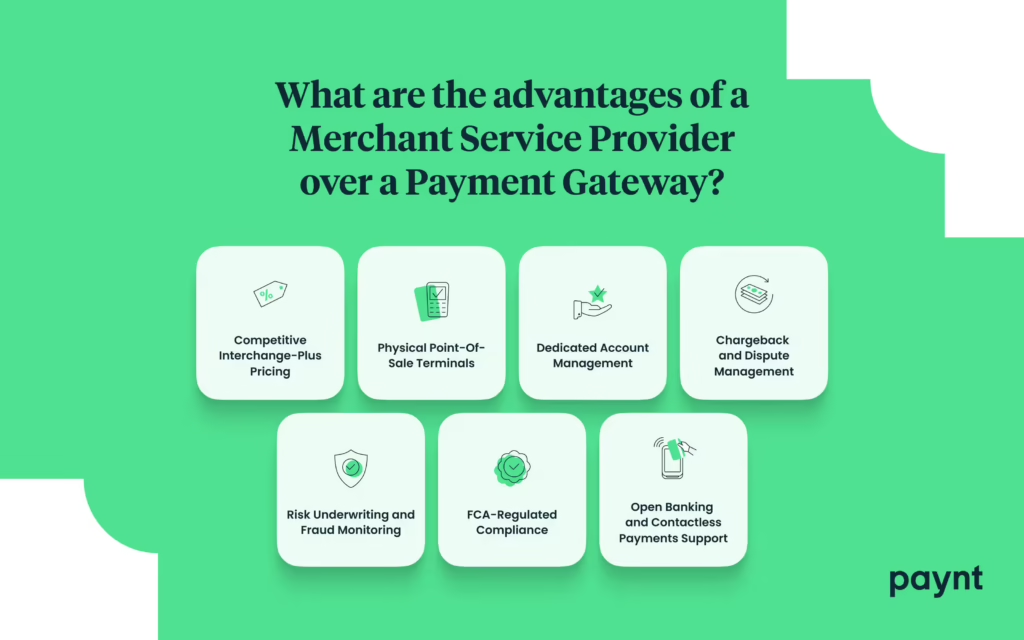
The advantages of a merchant service provider over a payment gateway include:
- Interchange-Plus Pricing: MSPs provide access to competitive interchange-plus pricing models as they hold a direct acquiring relationship with card schemes
- Physical POS Terminal Infrastructure: MSPs supply physical card terminals and integrated card machines for in-person payments whilst a payment gateway operates at the software level only
- Dedicated Account Management: MSPs provide dedicated account managers to improve service quality, resolve specific problems or develop solutions
- Chargeback and Dispute Management: MSPs help manage chargeback resolution as the financial intermediary between the merchant and the card schemes
- Risk Underwriting and Fraud Monitoring: MSPs assess and underwrite transaction risk as they hold financial responsibility for the merchant’s payment activity under UK acquiring agreements
- FCA-Regulated Compliance: MSPs operate under FCA regulation and UK acquiring bank obligations as a regulated financial entity
- Open Banking and Contactless Support: MSPs support local UK payment schemes including Open Banking and NFC contactless payments
What is a Payment Gateway?
A payment gateway is a secure, cloud-based technology that acts as the technical intermediary between a merchant’s e-commerce website or physical POS terminal and the acquiring bank. This technology captures and encrypts customer payment data using TLS protocols and transmits the encrypted data to the payment processor. The gateway then returns an authorisation response to the merchant in real time.
The gateway is a sub-component of the broader payment ecosystem. It executes the data transmission layer but does not own the financial relationship between the merchant and the acquirer.
In the UK, payment gateways operate under PCI-DSS standards and enforce 3D Secure (3DS2) authentication in compliance with Strong Customer Authentication (SCA) requirements mandated by the FCA.
The main features of a payment gateway are:
- Encryption and Security: The gateway encrypts sensitive cardholder data using SSL/TLS protocols to ensure secure transmission of data
- Real-Time Authorisation: Transmits authorisation requests to the acquiring bank and returns an approval or decline response in real time
- Tokenisation: Replaces sensitive card data with a unique token enabling secure storing of cardholder data on the merchant’s systems.
- 3D Secure Authentication: This security layer prompts customers for a password or biometric verification, fulfilling Strong Customer Authentication (SCA) requirements
- PCI-DSS Compliance: ensures the gateway maintains a secure environment, protecting UK businesses from data breaches and significant financial penalties.
Who Needs a Payment Gateway?
A payment gateway is needed by any business that accepts payments online, card-not-present payments and recurring billing or subscriptions payments.
Businesses that specifically need a payment gateway include:
- E-commerce retailers that process card-not-present (CNP) transactions where physical card verification is unavailable at the online checkout point
- SaaS and subscription platforms that accept payments through recurring billing by storing card data securely for card-not-present transactions
- Telephone and mail order merchants that utilise a virtual terminal for CNP transactions require a software interface to manually capture and process card payments
- International businesses that require multi-currency processing for cross-border transactions
What are the Advantages of a Payment Gateway over a Merchant Service Provider?
The advantages of a payment gateway over a merchant service provider are listed below:
- Acquirer Flexibility: A standalone gateway connects to multiple acquiring banks independently, whereas a bundled gateway is tied to the MSP’s single acquiring relationship
- Broader Platform Compatibility: A standalone gateway offers wider API compatibility with e-commerce platforms like Shopify and Magento where the MSP’s bundled gateway may not natively integrate
- Multi-Currency Processing: A standalone gateway typically supports broader multi-currency processing across international card schemes where the MSP’s acquiring agreements may restrict currency options
- Lower Entry Cost: A standalone gateway carries lower upfront costs for businesses that already hold a merchant account and require only the technical transaction layer
Which is Better, Merchant Service Providers or Payment Gateways?
| Business Situation | MSP with Bundled Gateway | Standalone Gateway |
| Starting a new business | Provider covers the full payment stack and terminal infrastructure from day one | Online payments only |
| Requiring in-store POS terminals | MSPs provide physical card terminals for card-present transactions | Does not supply or manage POS hardware |
| Requiring fraud prevention tools | Dedicated fraud monitoring, CVV checks, and AVS verification as part of the service | Applies fraud screening at the data transmission level only |
| Requiring chargeback management | Fully managed by the MSP including dispute resolution and liability protection | A standalone gateway does not manage chargebacks |
| Selling in-store and online | Provide unified reporting across card-present and Online transactions | Does not cover physical POS infrastructure |
| High transaction volumes | Offer preferential rates, dedicated account management, and risk underwriting at scale | Only beneficial if the standalone gateway offers lower per-transaction fees |
| Requiring multi-currency support | Yes but depends on the MSP’s acquiring agreements | Typically offer broader multi-currency processing |
| Switching acquiring banks | A bundled gateway is tied to the MSP’s acquiring relationship | A standalone gateway connects to multiple acquirers independently |
| Requiring specific platform integrations | Depends on the MSP’s bundled gateway API capabilities | Offer broader API compatibility with platforms like Shopify |
