
Merchant Services Fees: Definition, All Types & How To Reduce Them
Merchant services fees are the costs businesses pay to accept and process credit card and debit card payments from customers. Merchant services fees usually cost between 1.5% to 3.5% per transaction plus recurring account costs. Merchant services fees include interchange fees paid to issuing banks, assessment fees collected by card networks like Visa and Mastercard, and processor markups retained by payment processors.
These fees also include monthly account fees, PCI compliance fees, payment gateway fees, batch fees, chargeback fees, equipment rental fees, and contract related penalties. Pricing models such as flat rate pricing, interchange plus pricing, and tiered pricing determine how these fees are calculated and disclosed.
In this article we discuss what merchant services fees are, all the different types of fees charged to merchants, different pricing models and how to reduce these fees for businesses.
What Are Merchant Services Fees?
Merchant services fees are the costs businesses pay to accept and process credit card and debit card payments from customers. These costs consist of three primary components: interchange fees paid to the card-issuing bank, assessment fees collected by card networks like Visa and Mastercard, and the processor’s markup for facilitating transactions. The interchange fee represents the largest portion of merchant services fees and varies based on card type, transaction method, and merchant category code.
Merchant services fees are determined by multiple factors including transaction volume, card-present versus card-not-present entry methods, and business classification. These fees encompass both percentage-based charges applied to each transaction and fixed costs such as PCI compliance fees, payment gateway access and other payment service fees. The processing fee differs significantly between debit card transactions and credit card transactions, with rewards cards typically carrying higher interchange rates.
What Are the Different Types of Merchant Services Fees?
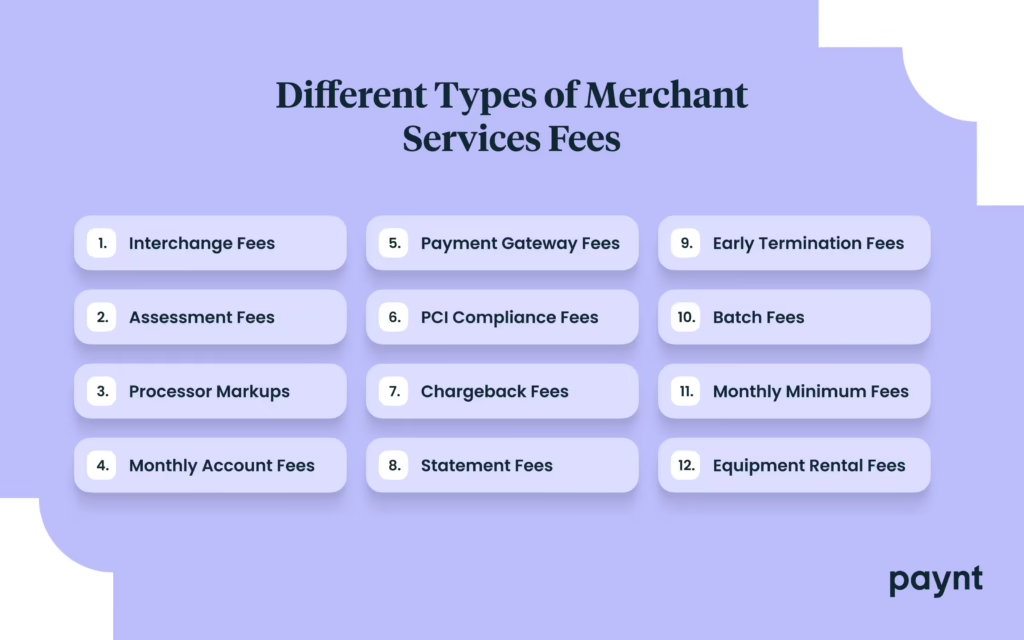
The different types of merchant services fees represent distinct charge categories that serve different functions within the payment processing ecosystem such as fees related to transactions, account maintenance and situational fees. Each fee type carries specific rate structures, payment triggers, and cost allocation methods that impact the merchant’s bottom line. The different types of merchant services fees are:
1. Interchange Fees
2. Assessment Fees
3. Processor Markups
4. Monthly Account Fees
5. Payment Gateway Fees
6. PCI Compliance Fees
7. Chargeback Fees
8. Statement Fees
9. Early Termination Fees
10. Batch Fees
11. Monthly Minimum Fees
12. Equipment Rental Fees
1. Interchange Fees
Interchange fees are the costs paid directly to the card-issuing bank for each debit and credit card transaction processed. When a customer makes a card payment, the business’ acquiring bank pays this interchange fee to the cardholder’s issuing bank. The interchange fee covers the issuing bank’s risk, fraud prevention costs, and handling expenses for the transaction.
Interchange fees are not negotiable as card networks establish these rates uniformly across the payment processing industry. Card networks like Visa, Mastercard, Discover, and American Express set interchange rates based on card type, transaction method, merchant category code, and transaction size.
2. Assessment Fees
Assessment fees are non-negotiable charges from the card networks (Visa, Mastercard, American Express, Discover) for using their payment systems. Card networks collect assessment fees to fund network infrastructure, fraud prevention systems, and brand development initiatives. These fees are typically a fixed percentage of the merchant’s gross monthly transaction volume, ranging from 0.13% to 0.15% for Visa, Mastercard and American Express. The assessment fee applies to all transactions regardless of the processor or pricing model used by the merchant.
Assessment fees differ from interchange fees as they compensate the card brand rather than the issuing bank. Merchants cannot negotiate assessment fees as card networks set these rates at the network level.
3. Processor Markups
Processor markups are the fees charged by merchant service providers and acquiring banks on top of interchange and assessment fees for facilitating payment processing. These fees represent the cost of the processor’s fees and their profit margin. The processor markup covers payment gateway services, customer support, risk management, settlement services, and technology infrastructure maintenance. Processors charge these markups either as a total flat rate or a variable interchange-plus markup fee structure.
4. Monthly Account Fees
Monthly account fees are recurring charges for maintaining an active merchant account with a payment processor. These fees range from £0 to £50 per month depending on the service provider and pricing model. The monthly account fee covers account maintenance, customer service access, reporting tools, and administrative overhead for the merchant services provider.
Merchants pay this recurring charge regardless of whether they process transactions during the billing period. Many modern payment processors have removed monthly account fees in favor of per-transaction pricing models.
5. Payment Gateway Fees
Payment gateway fees are charges businesses pay for the technology that securely transmits payment data between the merchant and the payment processor. Payment gateways facilitate online, in-app, and in-store transactions. Gateway fees typically include a percentage of each sale plus a fixed fee such as 2.8% + £0.25 for online transactions. The payment gateway fee covers encryption services, tokenisation, fraud detection tools, and API access for integrating payment processing into websites and applications.
E-commerce merchants and card-not-present businesses rely on payment gateways to process online transactions, while brick-and-mortar stores use physical terminals that function as in-store payment gateways.
6. PCI Compliance Fees
PCI compliance fees are charges related to maintaining Payment Card Industry Data Security Standards (PCI DSS) compliance. These fees range from £5 to £50 per month or £60 to £600 annually depending on the merchant’s validation level and processor. The PCI compliance fee covers security assessments, vulnerability scanning, compliance monitoring, and documentation services required to meet card network security standards. Merchants must maintain PCI compliance to reduce data breach risk and avoid non-compliance penalties.
7. Chargeback Fees
Chargeback fees are charges merchants pay to the payment processor when a customer disputes a transaction and the card issuer reverses the payment. These fees range from £10 to £100 per chargeback incident regardless of whether the merchant wins the dispute. The chargeback fee covers the administrative costs of dispute processing, investigation, and documentation review for the processor and acquiring bank.
8. Statement Fees
Statement fees are monthly charges for generating and providing detailed transaction reports and account statements. These fees range from £0 to £20 per month depending on the processor and service level. The statement fee covers the cost of producing paper statements, online reporting access, and detailed transaction breakdowns. Many modern processors have eliminated statement fees by providing electronic statements and online dashboards at no additional cost.
9. Early Termination Fees
Early termination fees are penalties charged when merchants cancel their processing agreement before the contract term expires. These fees can range from £100 to £500 depending on the remaining contract length and processor terms. The early termination fee compensates the processor for lost revenue and covers the cost of account closure, equipment retrieval, and administrative processing. Merchants locked into multi-year contracts face the highest termination penalties, typically calculated as a flat fee or percentage of expected future revenue.
10. Batch Fees
Batch fees are small charges assessed by payment processors each time a group of transactions is settled with the card network at the end of a business day. These fees typically range from £0.10 to £0.35 per batch settlement depending on the processor. The batch fee covers the cost of processing settlement files, transferring funds, and reconciling transactions between the merchant account and card networks. Merchants who settle transactions once daily pay one batch fee per day.
11. Monthly Minimum Fees
Monthly minimum fees are charges applied when a merchant’s monthly processing fees fall below a predetermined threshold. These fees range from £20 to £100 per month and represent the difference between actual fees incurred and the monthly minimum requirement. The monthly minimum fee ensures processors receive baseline revenue from low-volume merchants who do not generate sufficient transaction fees. High-volume merchants who exceed the monthly minimum threshold do not pay this fee.
12. Equipment Rental Fees
Equipment rental fees are monthly charges for leasing payment terminals, card readers, and point-of-sale hardware from the payment processor. These fees range from £10 to £100 per month per device depending on equipment type and features. The equipment rental fee covers device maintenance, replacement for malfunctioning units, and technical support for hardware issues. Merchants can avoid rental fees by purchasing equipment outright or using mobile card readers with lower upfront costs.
What Are the Different Types of Merchant Fee Pricing Models?
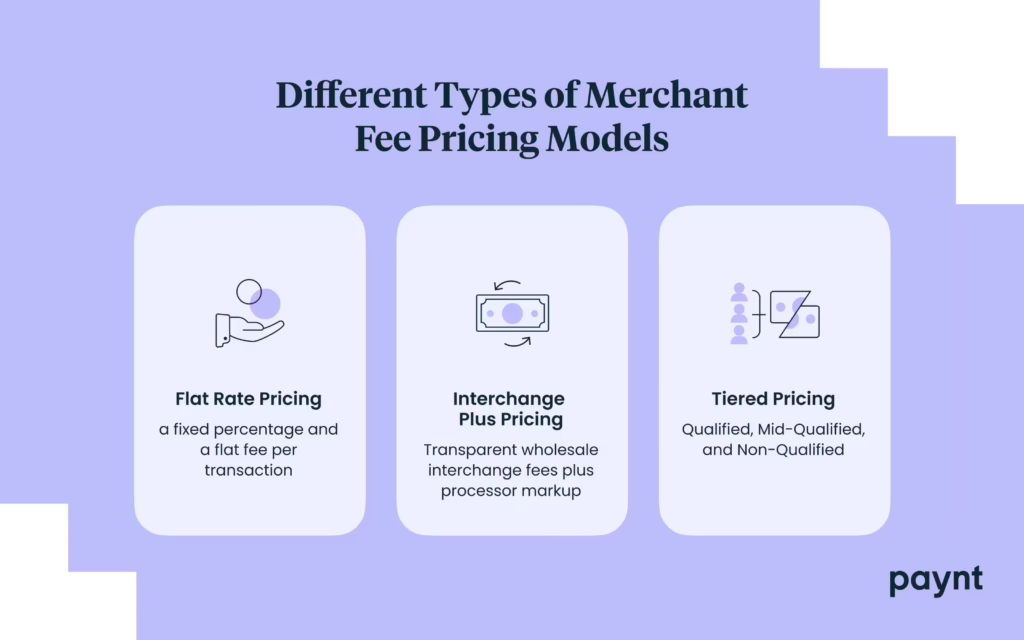
The different types of merchant fee pricing models refer to the financial frameworks that determine how businesses calculate and pay merchant services fees for credit card and debit card processing. The pricing model selection determines whether merchants pay fixed rates per transaction or variable rates based on card type, transaction method, and interchange category.
The 3 different types of merchant fee pricing models are:
1. Flat Rate Pricing
2. Interchange Plus Pricing
3. Tiered Pricing
1. Flat Rate Pricing
Flat rate pricing charges a fixed percentage and a flat fee per transaction, regardless of card type or interchange category. The flat rate structure combines interchange fees, assessment fees, and processor markups into one comprehensive rate that remains constant across all transaction types. This pricing model is best for small businesses, micro-merchants, and startups seeking predictable costs without complex fees typically charging 1.75% to 3.5% plus £0.10 to £0.30 per transaction.
The payment processor absorbs the difference between the flat rate charged and actual interchange costs, profiting more on low-cost debit transactions while earning less on premium credit card transactions.
2. Interchange Plus Pricing
Interchange plus pricing is a transparent, cost-plus merchant pricing model where businesses pay the exact interchange rates set by card networks such as Visa & Mastercard plus a fixed markup from the processor. The fixed markup from the processor is typically expressed as a percentage plus a per-transaction fee such as 0.20% + £0.05.
This pricing model is best for established businesses, high-volume merchants, and companies seeking cost optimisation. The interchange plus structure separates the non-negotiable network costs from the negotiable processor markup, providing complete visibility into the true cost of payment processing. Merchants pay the exact interchange rate set by card networks plus a consistent processor markup regardless of card type or transaction method.
3. Tiered Pricing
Tiered pricing is a merchant services pricing model that groups credit card transactions into 3 rate categories based on card type and transaction risk. The three tiers are Qualified, Mid-Qualified, and Non-Qualified. Qualified transactions receive the lowest rates for standard debit cards and non-rewards credit cards processed in person. Mid-Qualified and Non-Qualified transactions carry progressively higher rates for rewards cards, business cards, keyed-in entries, and card-not-present payments.
This pricing model costs merchants significantly more than interchange plus pricing as processor markups vary by tier and transactions frequently downgrade to higher-cost categories.
How Can Businesses Reduce Their Merchant Services Fees?
Businesses can reduce their merchant services fees through the following strategies:
- Choose the Right Payment Processor: Evaluate fee structures against your business’s transaction patterns, volume, and industry requirements.
- Audit Current Processing Statements: Review three to six months of statements to identify excessive fees and unnecessary charges that inflate total processing costs.
- Switch to Interchange Plus Pricing: Move from tiered or flat rate pricing to transparent interchange plus models that typically reduce effective rates.
- Negotiate Processor Markups: Leverage processing volume and competitive quotes to reduce basis points with your provider.
- Encourage Debit Card Payments: Promote debit card usage over credit cards through signage or small incentives. Debit card transactions incur lower interchange fees than credit cards.
- Set Minimum Card Transaction Amounts: Establish a minimum purchase amount for card payments between £1 and £10 to offset fixed per-transaction fees on small purchases.
- Consider Alternative Payment Methods: Offer lower-cost payment options such as ACH bank transfers and pay-by-bank services. ACH transactions typically cost 0.5% to 1% with a capped fee, compared to 1.5% to 3.5% for credit card transactions.
- Reduce Chargebacks: Implement clear billing descriptors, detailed product descriptions, and responsive customer service to eliminate chargeback fees.
- Eliminate Unnecessary Fees: Remove monthly account fees, statement fees, annual fees, and equipment rental costs that do not provide corresponding value.
- Review and Update Equipment: Replace outdated terminals and purchase rather than lease to save annually in rental fees.
How Can Paynt Help Businesses Save on Merchant Services Fees?
How Paynt help businesses save on merchant services fees are listed below:
• No Setup Fees: Eliminates upfront costs that traditional processors charge for account setup and equipment configuration.
• Low Monthly Account Fees: Affordable monthly pricing structures that reduce recurring costs
• Fee-Free Tipping Functionality: Includes integrated tipping features on card machines without additional transaction fees, allowing businesses to maximise employee tips without increasing processing costs.
• Transparent Interchange Plus Pricing: Paynt displays exact interchange fees enabling merchants to save on total processing costs with full transparency.
• No Hidden Fees: Paynt do not charge hidden fees that inflate total processing costs. All fees are transparent and explicitly outlined in the service agreement.
• No Long-Term Contracts: Offers flexible month-to-month agreements without early termination fees
