
How to Become a Merchant Service Provider: Steps, Costs & The ISO Alternative
Becoming a Merchant Service Provider requires FCA authorisation, the right banking partnerships, and a compliant technical infrastructure. The total cost ranges from £200,000 to £500,000 upfront, with ongoing annual costs of £75,000 to £200,000 or more. For this reason, many businesses choose the ISO model instead.
A Merchant Service Provider delivers the complete financial infrastructure to accept, process, and settle card payments directly. An ISO resells access to that infrastructure on behalf of acquiring banks and payment processors, without the regulatory burden, capital requirements, or technical overhead of building it independently.
In this article, we cover what a Merchant Service Provider is, how to become an MSP, the cost of setting one up, how the ISO model works as a faster and lower cost alternative, and the exact steps required to pursue either path in the UK.
What Is a Merchant Service Provider?
A Merchant Service Provider (MSPs) is a company that is a third-party financial intermediary enabling businesses to accept and process electronic payments such as credit cards, debit cards, and online transactions. This provider establishes the core technical and financial infrastructure required to transfer funds between businesses, customers, banks, and payment card networks.
Merchant Service Providers deliver merchant services to businesses to help improve payment operations beyond the core infrastructure of processing payments. These providers supply hardware and software such as POS terminals, mobile card readers, and payment gateways. They facilitate online transactions through e-commerce integration, virtual terminals, and recurring billing systems.
What is an ISO?
An ISO (Independent Sales Organisation) is a third-party entity authorised by acquiring banks and payment processors to resell merchant services, payment processing solutions, and financial products to businesses. ISOs operate as intermediaries between merchants and acquiring banks, facilitating the onboarding, underwriting, and ongoing management of merchant accounts without directly holding or processing funds.
ISOs give businesses access to payment acceptance infrastructure. This includes POS terminals, payment gateways, and mobile card readers. These are made available through direct partnerships with acquiring banks and payment processors. ISOs typically provide tailored technology solutions to businesses such as chargeback management, fraud prevention tools, and analytics reporting. These tailored solutions enable ISOs to generate revenue through residual income from transaction processing fees, equipment leasing, and value-added services.
What is the Difference Between an ISO vs a Merchant Service Provider?
A Merchant Service Provider delivers the full financial infrastructure to accept, process, and settle card payments directly, whilst an ISO acts as an authorised reseller of payment services on behalf of acquiring banks and payment processors.
- Merchant Service Provider: Manages the full payment lifecycle on behalf of a business, providing the merchant account, underwriting transaction risk, and ensuring FCA-regulated compliance.
- Independent Sales Organisations: An ISO operates as a third-party sales and distribution channel for acquiring banks. It onboards merchants and provides access to payment infrastructure including POS terminals, payment gateways, and mobile card readers through its sponsoring bank. ISOs do not hold or settle funds at any point.
Below is a table outlining the differences between an ISO and a Merchant Service Provider:
| ISO | Merchant Service Provider (MSP) | |
| Fund Settlement | Does not hold or settle funds at any point | Holds funds in the merchant account before transferring to business bank account |
| Risk Underwriting | Does not underwrite transaction risk | Underwrites and assumes financial liability for merchant transactions |
| Merchant Account Provision | Does not provide a merchant account directly | Provides a dedicated merchant account to hold and process funds |
| Regulatory Status | Not FCA-regulated as a financial entity | FCA-regulated, operates under UK acquiring bank agreements |
| Merchant ID (MID) | Does not issue a MID | Issues a Merchant ID (MID) under UK acquiring bank agreements |
| Relationship to Acquiring Bank | Resells services on behalf of a sponsoring acquiring bank | Operates directly as or under an acquiring bank |
| PCI-DSS Compliance | Required for data handling at point of transmission | Required as part of the broader payment infrastructure |
| Payment Hardware and Software | Supplies POS terminals, gateways, and card readers through sponsoring bank | Supplies POS terminals, gateways, and card readers directly |
How to Become a Merchant Service Provider?
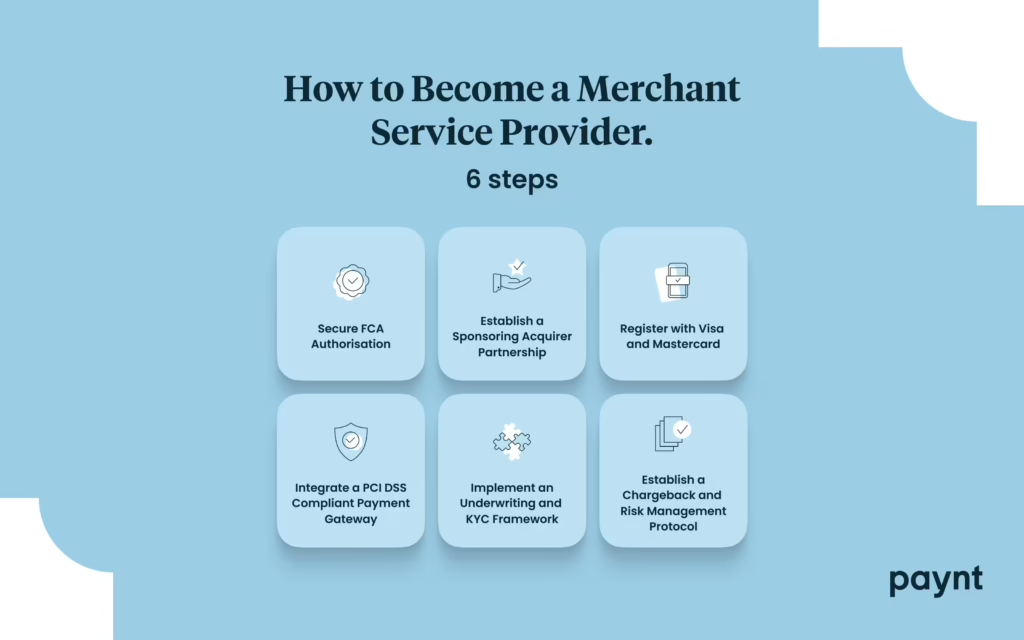
Becoming a Merchant Service Provider requires FCA authorisation, the right banking partnerships, and a compliant technical infrastructure. A Merchant Service Provider operating in the UK must obtain authorisation from the Financial Conduct Authority (FCA) under the Payment Services Regulations 2017.
To become a Merchant Service Provider, follow the below steps:
1. Secure FCA Authorisation
Register with the FCA as an Authorised Payment Institution (API) or Small Payment Institution (SPI) under the Payment Services Regulations 2017 in the UK. Without this registration, businesses cannot legally handle merchant funds or act as a payment intermediary in the UK. FCA authorisation as an API requires demonstrable capital reserves of at least £125,000 for full API status, a figure that catches many applicants off guard.
2. Establish a Sponsoring Acquirer Partnership
Negotiate a sponsorship agreement with a licensed acquiring bank. The acquirer assumes regulatory liability and provides the BIN sponsorship required to access Visa and Mastercard networks on the organisation’s behalf. Acquiring banks are selective about who they sponsor, and without a demonstrated compliance framework and credible merchant pipeline, many applicants stall at this stage for months.
3. Register with Visa and Mastercard
Apply and register with both Visa and Mastercard through the sponsoring acquirer. Registration grants the business the legal right to board and service merchants.
4. Integrate a PCI-DSS Compliant Payment Gateway
Deploy a payment gateway that meets PCI-DSS Level 1 compliance. Card scheme rules require all transaction data to be encrypted, tokenised, and processed within a certified secure environment.
5. Implement an Underwriting and KYC Framework
Develop a merchant onboarding process that includes Know Your Customer (KYC) checks, Anti-Money Laundering (AML) screening, and risk-based underwriting. The sponsoring acquirer holds the organisation accountable for every merchant it boards onto the network. In our experience, securing a sponsoring acquirer partnership is extremely difficult without demonstrating a credible KYC and underwriting framework first.
6. Establish a Chargeback and Risk Management Protocol
Build operational procedures for dispute resolution, chargeback liability management, and fraud monitoring. Card schemes require registered intermediaries to maintain merchant chargeback ratios below defined thresholds to retain active registration status.
Visa and Mastercard generally require registered intermediaries to maintain merchant chargeback ratios below 1%.
What is the Cost of Becoming a Merchant Service Provider?
The cost of becoming a merchant service provider ranges between £200,000 to £500,000+. This cost involves a combination of regulatory fees, infrastructure investment, and ongoing operational expenditure. The ongoing annual cost ranges between £75,000 to £200,000+ depending on scale, transaction volume, and the breadth of services offered.
Below are the typical costs of becoming a merchant service provider:
- FCA application fee ranges from £500 to £5,000. A Small Payment Institution (SPI) falls into Category 2 at £500, while an Authorised Payment Institution (API) falls into Category 4 at £2,500 or Category 5 at £5,000
- Regulatory capital reserve requires a minimum of £125,000 for an Authorised Payment Institution providing merchant acquiring and payment execution services under the Payment Services Regulations 2017.
- Legal and consultancy fees for preparing FCA-compliant governance frameworks, anti-money laundering procedures, and financial controls typically add £15,000 to £50,000.
- Anti-money laundering system setup carries an additional cost of £5,000 to £20,000. This covers KYC verification tools, sanctions and PEP screening software, transaction monitoring system and SAR filing procedures required under the Money Laundering Regulations 2017
- PCI DSS Level 1 certification is required for providers processing over 6 million card transactions annually. Costs range between £40,000 and £100,000 in QSA onsite audit fees, quarterly vulnerability scans, penetration testing, and Report on Compliance (ROC) submission.
- Payment gateway development and integration costs between £10,000 and £30,000. This covers API integration with the acquiring bank, tokenisation and encryption configuration.
- Visa and Mastercard scheme integration costs between £10,000 and £30,000. These costs cover BIN sponsorship configuration, scheme registration fees, and Payment Service Provider agreement setup with the sponsoring acquirer.
- Secure data storage environments compliant with PCI DSS requirements cost between £5,000 and £15,000. These costs cover encrypted server infrastructure, firewall configuration, and access control systems.
- Visa and Mastercard scheme fees, including membership and per-transaction assessment charges, apply continuously and vary by transaction volume.
- Professional indemnity insurance, mandatory for FCA-regulated entities, carries annual premiums of £5,000 to £25,000. In our experience, a well-documented AML and governance structure can reduce premiums materially.
- Fraud and chargeback management systems cost between £2,000 and £10,000 annually for mid-tier providers. These costs cover real-time transaction monitoring, dispute resolution tools, and chargeback ratio reporting required by Visa and Mastercard scheme rules. On Paynt’s platform, merchants maintaining chargeback ratios below 1% incur significantly lower dispute management overhead.
- Ongoing FCA regulatory reporting and compliance maintenance costs £3,000 to £10,000 per year. These costs cover annual returns, capital adequacy reporting, and safeguarding compliance reviews.
What are the Advantages of Becoming an ISO vs a Merchant Service Provider?
The advantages of becoming an ISO over a merchant service provider are lower barriers to entry, reduced regulatory exposure, and faster time to market. These advantages exist because an ISO operates under a sponsoring acquirer’s infrastructure and regulatory permissions.
The advantages of an ISO over the MSP structure is detailed below:
- Reduced the barrier to entry
An ISO does not need to fund its own merchant acquiring infrastructure. The sponsoring bank provides the processing backbone. This eliminates the need for direct investment in settlement systems, compliance frameworks, and banking relationships that an MSP must establish independently. ISOs can also access white label merchant services, allowing them to go to market under their own brand without building proprietary technology.
- Reduced regulatory exposure limits operational risk
An ISO operates under the acquiring bank’s FCA permissions and card scheme registrations. This reduces the legal overhead, internal compliance costs, and institutional risk that come with operating as a fully regulated MSP. - Faster time-to-market accelerates portfolio growth
An ISO can begin onboarding merchants within weeks of securing a sponsorship agreement. An MSP must build acquiring technology, obtain scheme approvals, and establish banking partnerships before processing a single transaction. - Scalable agent networks expand geographic reach
An ISO can recruit sub-agents and sales partners across multiple regions without expanding its own underwriting, compliance, or settlement capacity which increases its fixed cost base. Each new agent adds merchant volume directly to the ISO’s residual income stream. - Reduced liability for chargebacks and fraud losses protects margins
The sponsoring acquirer absorbs the primary financial risk associated with merchant chargebacks and fraudulent transactions. An ISO’s exposure is typically limited to clawback provisions on residual payments rather than direct settlement losses. - Flexible portfolio diversification strengthens market positioning
An ISO can partner with multiple acquiring banks simultaneously, offering merchants a range of pricing structures, terminal options, and settlement terms. An MSP is constrained by its own single acquiring infrastructure and processing capabilities.
ISO Merchant Services: How the Business Model Works
The ISO Merchant Services business model works by building a contractual partnership between your organisation and a licensed acquiring bank or Merchant Service Provider. The following 4 stages describe how the business model operates from partnership formation to revenue distribution:
1. Merchant acquisition and account setup
The ISO uses sales teams and agent networks to acquire merchants, typically targeting small-to-medium-sized businesses. The ISO manages the full onboarding process, including application submission, documentation collection, and underwriting coordination with the sponsoring acquirer.
2. Transaction processing and settlement
The acquirer processes and settles each transaction on behalf of the merchant. The acquirer deducts interchange fees, scheme assessments, and its own markup before distributing the ISO’s residual share.
3. Revenue model and profit structure
The ISO earns revenue through four primary channels:
- Residual income: a percentage of every transaction your merchants process, paid on a recurring basis
- Rate markups: margins applied on top of the acquirer’s wholesale processing rates
- Hardware revenue: upfront or recurring income from POS terminal and card reader sales or leases
- Service fees: monthly account charges and setup fees collected at onboarding or renewal
4. Ongoing Account Management and Merchant Support
The ISO provides dedicated merchant support, including terminal replacements, PCI compliance assistance, and dispute resolution. The acquirer processes and settles each transaction on behalf of the merchant, deducting interchange fees, scheme assessments, and its own markup before distributing the ISO’s residual share.
How to Become an ISO for Merchant Services
To become an ISO for merchant services in the UK, you must secure a sponsorship agreement with a licensed acquiring bank, obtain the appropriate regulatory status from the FCA, and complete card scheme registration with Visa and Mastercard. The following 6 steps outlines how to become an ISO for merchant services:
- Register a limited company with Companies House and prepare a business plan that includes 3-year revenue projections, target merchant segments, a documented AML policy, and evidence of £50,000 to £100,000 in working capital.
- Secure a sponsorship agreement with a UK-licensed acquiring bank that holds active principal memberships with Visa and Mastercard. The acquirer provides access to its BIN, processing infrastructure, and scheme certifications.
- Register with Visa and Mastercard through the sponsoring acquirer. The registration requires background checks on all directors and shareholders holding 25% or more ownership, a non-refundable registration fee, and typically takes 4 to 8 weeks.
- Obtain FCA regulatory status through either direct FCA authorisation or an Appointed Representative (AR) arrangement under a principal firm that already holds the relevant permissions.
- Deploy a CRM and risk management framework that integrates with the acquirer’s reporting systems to monitor merchant onboarding, transaction volumes, chargeback ratios, and fraud alerts in real time.
- Select a PCI DSS Level 1 compliant payment gateway and terminal hardware that supports 3D Secure 2.0 authentication, contactless NFC payments, chip-and-PIN verification, and mobile wallet acceptance for Apple Pay and Google Pay.
ISO Merchant Services with Paynt
Paynt provides acquiring-as-a-service infrastructure for Independent Sales Organisations, offering industry-leading revenue shares on every transaction and real-time commission reporting for full visibility into portfolio earnings and trends. ISOs access fully digital merchant onboarding with turnaround within 1 business day, a complete payment stack including POS terminals, SoftPOS, and e-commerce integration, and dedicated partner support.
Get in touch to become a Paynt ISO partner today.
